![]() |
Transformation
and Recovery:
|
|
||||||||||||||||
|
Other Resources |
||||||||||||||||||
|
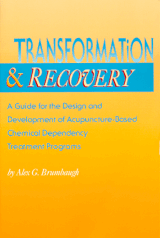
Transformation and Recovery, now in its sixth printing, is the only definitive book on acupuncture and addiction recovery. This web page contains information about the book, its complete table of contents, the excerpted section introductions, and links to related sites. More than a manual or "how-to" book, Transformation and Recovery offers a bold and insightful philosophical and historical interpretation of addiction and recovery. What professionals are saying about this landmark book:
About the author: Alex Brumbaugh has been in the chemical dependency treatment field since 1983, and in education since 1967. For 9 years, he was the Director of the Santa Barbara Council on Alcoholism and Drug Abuse's "Project Recovery," one of the largest providers of adult drug and alcohol treatment services in Santa Barbara County - a program that began as a two-hour-per-day, acupuncture demonstration project in 1988. He has also been an Associate Faculty Member in Human Services and Social Science at Alan Hancock College in Santa Maria, California, and has taught numerous workshops on addiction and recovery issues. He has been a consultant to acupuncture programs, and has conducted Certification trainings for the National Acupuncture Detoxification Association. His publications include "Acupuncture: New Perspectives in Chemical Dependency Treatment" (Journal of Substance Abuse Treatment, V10 No1, pp 35-43), and "Acupuncture as a Foundation for Treatment Services" (Addiction and Recovery, November/ December, 1993, pp 26-28), and "Why Drug Courts Work." He is currently a consultant and educator in private practice.
Following are the excerpted section introductions and a partial bibliography for Transformation and Recovery. Click here for ordering information. Part I - The LandscapeAmong the more penetrating human challenges of working in or thinking about the field of addiction and recovery is that we find ourselves truly on a vast frontier. We are entering upon a landscape that has not been accurately mapped. One has perhaps seen replicas of the quaint and inaccurate maps of the globe and of unexplored land masses that were actually used by Western explorers from the 15th through the 19th Centuries. The earliest maps of the North American continent, for example, which were based upon earlier explorations (and even more perhaps upon presumptive and wishful thinking, and an explorers arrogance), often depict a mythical river, named "Buena Ventura," which would provide the hoped-for all-water-route through the continents interior from the Atlantic to the Pacific Oceans. Two things are important in this phenomenon of inaccurate map-making. First, it made exploration in general an enterprise characterized by unfolding disappointment after disappointment that things werent where they were supposed to be. The territory didnt fit the map. That disappointment imposed, after a time, a certain emotional perseverance on the explorers who persisted in the work. Perseverance was imposed, and humility, because there came for them the implicit knowledge that they were transition figures in this drama of exploration and discovery, that they would likely never live to see the precise form and shape of the lands they were mapping. That satisfaction of completion would have to be left to later explorers and cartographers. We might say that, in order to survive, both emotionally and physically, these explorers had to be content to live in the process of exploration rather than in the outcome. Second, it is important to recognize that these awarenesses didnt keep them from making maps. The maps they continued to make, based upon incomplete information, and though consequently inaccurate, were invaluable in the frontier process, providing the sole beacons for subsequent exploration. These early frontier-folk were obliged, therefore, whether consciously or unconsciously, to embrace their own imperfections and limitations in order to survive. The maps they left may appear, in retrospect, arrogant in their presumptiousness. Yet the courage to make them allowed subsequent exploration to take place, and ultimately accurate maps to be drawn. It is important to note that maps are never the same as the lands they depict, regardless of their technical accuracy. They are depictions only, rough guides. Elevation coding by color on a flat surface, no matter how "accurate," can never capture the splendor of the Rocky Mountains or the breath-taking expanse of the Great Plains. Confusing a map with the territory it is meant to represent is to be beguiled by symbols. For the traveler, particularly an explorer, this conclusion can, of course, be disastrous. Therefore, we realize that our map-making efforts in the field of addiction and recovery are best tempered with humility, with an understanding that we cannot ultimately know this reality my means of our maps, and that we who enter this field are transition figures on a landscape whose true dimensions and nature we may not live to see in any totality. And we must make the maps just the same, knowing that the terrain we attempt to describe is likely more complicated, and probably even less so, than what we see and attempt to describe at the present time. We trust that those who follow will find these maps useful - and will likely smile at their inaccuracies. Although we speak in metaphor, and will continue to use metaphor as a vehicle of understanding throughout this book, we should not forget that metaphors, like maps, are not the realities they represent. They are stories about that reality. The impact of addiction and recover, on the other hand, is not a metaphor. It is the reality, the landscape of late Twentieth Century America, which increasingly demands attention if we are to survive as a culture and a race. There are other reasons for beginning this journey with humility. People who work in the field of addiction and recovery have been said to have a "neurotic need to help others." A more helpful frame for this idea was suggested by psychologist Herbert Gravitz (1), who has called people in the helping profession "wounded artists." It is likely that people working in this field would be, in saner times, painters, poets, architects, novelists, sculptors, weavers, and potters. But for their woundedness, they would be working with materials other than human relationships. We were, according to Gravitz, wounded in relationship, and we must therefore be healed in relationship. We help in order to heal. It is important, he notes, to keep one foot in our woundedness and one foot in our own recovery. The arrogance that comes with forgetting this is an anathema to effectiveness on any level and can cause us to further hurt those we would help. Wise frontier explorers, exhilarated at their prospects, have two necessary tasks before their journey may commence. The first is to study extant maps. The second is to establish a center, a base of operations from which they will draw essential supplies and sustenance and to which they can return as a baseline reference for where they are. In this first section of our book, these are our two objectives: examining extant maps, and establishing a center. We will examine the psycho-historical and cultural landscape of the phenomenon of Western addiction in rather broad strokes. In pathological terms, this will be a journey through the addictive system, from branch to root. We will find this system, as the book Alcoholics Anonymous describes alcohol itself, "cunning, baffling, and powerful." (2) The addictive system is seductive as well, inviting us in, occluding reason, covering and displacing our best intentions. Drawing upon what we know of addiction recovery as a system, we will seek a place a stand in order to gain perspective, a center which will empower us to act. Return
to Table of Contents Part II - Treatment and the Phases of RecoveryWestern chemical dependency treatment (as distinct from recovery) is an inherently paradoxical proposition because it developed, as a model, from the Western exclusionary templates of medicine, psychology, and religion, which are among the most crystallized manifestations of the problem it is trying to solve. Traditional Western drug treatment is grounded in the addictive paradigm. It has historically been a rather bleak landscape. In the Introduction to this book, we said that a requirement for this work is "to speak two languages," and it is in the treatment arena where that demand is great. It is in the function of providing effective drug treatment that the addictive paradigm and the recovery paradigm must interface, and effective treatment must, in order to achieve its effectiveness, remain grounded and centered on the recovery side of things. We have characterized the Alcoholics Anonymous twelve step program, which is the premier recovery paradigm, as a counter-cultural reaction to this failure of the dominant Western Rationalist systems of medicine, psychology, and religion, to provide effective alcoholism treatment. Most contemporary Western treatment, since the ascent of AA, has the pretense of being grounded in recovery. It has, in general, co-opted, tacked on, or adapted the exterior trappings of the Twelve Step programs. But it hasnt, unfortunately, ventured to take any of the Twelve Steps itself! Recovery, as a system, has gotten the reputation of being exclusionary, which is a characteristics we have been ascribing to the addictive system as well. There is a tendency, born of survival, for people trying to remain centered in recovery to insulate themselves from the addictive system. This "cloistering impulse" is as understandable as people not wanting to go outside during a hurricane (as understandable, indeed, as a health professional choosing to deal with chemical dependency from the comfort and security of the private practice). Consequently, recovery from the isolating malaise of addiction often results in more isolation. Ideally, as the center grown stronger, there is a sort of spiraling movement in and out of two systems. But the fact is, since isolation itself is an addictive syndrome, there is no escaping the mouth of the tiger of addiction (3). The addiction treatment field is about the art of interfacing on multiple levels with the addictive system while at the same time remaining centered in the system of recovery. The most acute faces of the addictive system which manifest in the treatment arena, include, of course, the clients themselves. Also included, however, are the treatment funding community, the treatment administration and regulation establishment, and, not the least important, ones own unresolved personal addiction "trigger" issues. The effective treatment program, based in recovery principles, is continually involved in the process of healing on all of these levels. And so, in making the decision to attempt the challenge of transforming drug and alcohol treatment through the development of acupuncture-based treatment programs, we are compelled into the mouth of the tiger. This is a journey we must make. It will have its rewards. One reward is that we will find increasing numbers of allies within these systems, people already in recovery who are trying to bring recovery principles to this work. We will need these people for support. They will become as our extended family, a network of people who we need not like, but whom we need to love! Like an extended family, these are people who, "when you need to go there, they have to take you in." Among others we will find in this work are those who are experiencing sufficient desperation that they are open to the new perspectives of recover. These are our clients, earnest in discovering the tools of recovery, and our teachers as well, reminding us of from where we ourselves came. Just as the chemically dependent person begins the recovery journey with a redefinition and transportation of his/her relationship with the "drug of choice," so we begin our journey into the acupuncture-based chemical dependency treatment field in Chapters Four and Five with a description of some clinical realities concerning detoxification from drugs, and with an examination of psychoactive drugs themselves. We, too, seek to redefine and transform our relationship with these substances. In the looking glass of modern American culture, few phenomenon are as emotionally charged as our attitude about drugs and our stereotypes about those who use them addictively. Most of us have grown up learning about these substances in a Western context, with a Western moral frame of awareness, profoundly influenced by the institutions of education, government, church, and the media, for whom these substances have been invested with great and morally connotative power. These drugs, so we have been told, threaten the very fabric of our civilization. Yes, they have harmful effects (ironically, more so by far the licit than illicit ones). There is indeed pathology here, and lesion. In some drug categories, extended chronic use - and, in some cases, abrupt abstinence from extended chronic use - is life-threatening. However, from a treatment (and "prevention") perspective, using these facts to justify a moralizing posture helps not one iota. Health and recovery do not come from proselytizing. And thus, it is our goal to come to an understanding of these substances as indeed potent, but also as morally neutral. In Chapter Six of this section, we will describe the "mouth of the tiger," examining the Western models of treatment. Acupuncture can be effectively integrated into any of these models, and can help to transform them toward recovery. Also, we will find elements of these models that indeed have efficacy of their own: counseling, residential treatment, urine testing, and even drug therapies. We will also discover structures of great value which cut across and transcend all treatment modalities, such as the group process. and intervention. Acupuncture is among these transcendent systems. Treatment is a gateway to recovery. It is never a replacement for recovery (though that is what most clients often will be seeking - what AA calls an "easier, softer way"). Finding ones center in recovery is a life-long process. Chapter Seven describes the various phases of this process, and provides a more thorough analysis of the Twelve Step Recovery Programs, activities that complement them, some of their alternatives, and some of their more subtle resonances with the principles of Chinese medicine and acupuncture. Part III - Acupuncture-based Program Funding and DesignIn this section, our book becomes something of a manual. It includes information on getting a program started, about how public and private funding for drug and alcohol treatment works and is accessed, and about the process of education of communities about the efficacy of acupuncture. It is also about the process of acupuncture program design, proposal, and implementation, whether the program is to be developed as a free-standing program, or adjunctive with other services. If you, the reader, are an outsider to drug and alcohol treatment, this section of the book will offer strategies about how to get in. If you are already experienced in funding of chemical dependency funding treatment, this section will help with such matters as budget design, proposal writing, and other organizational considerations specific to acupuncture, including a vision of the future of acupuncture-based funding program design. As of this writing, public funding for all areas of public services is uncertain at the federal level, and in serious decline at the level of states, counties, and cities. We have suggested that all addicts eventually "hit bottom." That bottom may be physical, moral, familial, and so on. One can certainly speculate that, if, as Ann Wilson Schaef claims, society is an addict, its potential bottom will be financial in nature. For the crisis of public funding of all treatment, prevention, social, criminal justice, and health permeates all governmental levels and departments of our society, reaching its apex, of course with the problem of national public indebtedness. Fittingly, what is sometimes the "black belt" of Twelve Step Programs, or the "last stop on the Twelve Step track," is Debtors Anonymous! This crisis in finding for social and health, chemical dependency, and criminal justice services makes acupuncture program start-up prospects seem bleak; paradoxically, however, these drastic funding shortages are bringing into sharp focus the fact that society can no longer to afford the luxury of paying for the terribly expenses consequences of alcoholism and drug addiction (The Cost of Untreated Chemical Dependency) such as those that are born by the law and justice, health care, and social services systems. The simple and emerging truth is that untreated alcoholics and drug addicts represent a far more expensive proposition for the government than does the cost of effective treatment. This combination of emerging wisdom and desperation on the part of the government make the prospects for acupuncture in the next decade very good indeed, because acupuncture is portable, flexible, easy to administer, inexpensive, and effective. This does not make out job of program development easy, but it at least makes it possible. The structure of public funding is different in different states. Some smaller states administer drug and alcohol program services directly, or contract them out to private service providers. Larger states distribute funds and delegate responsibility for the administration of programs to counties or, less frequently, to cities. Some local jurisdictions rely solely on state and federal funds for substance abuse and related issues, and others use local tax revenues to pay for such services, either by providing the services themselves as governmental entities, or by contracting with private agencies. For purposes of explanation in this section of our book, we will use the fairly common structure of drug and alcohol treatment administration that is in place in California. It is important to note that the process of accessing the system is the same regardless of the ways in which the system may be organized in the readers locale. That is to say that all expenditure by government of public funds requires some degree of public scrutiny and accountability. In California, for example, the mechanism for this is the County drug and Alcohol Advisory Board. This mechanism may be different in different states, but the mechanism will be there in one form or another, and may he discovered by contacting the local or state agency responsible for administration of drug and alcohol treatment funds. We have provided in Appendix IX, Section B, contacts in each state for information about local funding mechanisms. Whatever for that mechanism takes in the readers own region, the basic procedures outlined in this section can be applied. Notes(Transformation and Recovery contains over 300 annotated footnote references): (1) Herbert L. Gravitz is a California pioneer in the Adult Children of Trauma (ACoT) clinical movement, and the quote is from a 1988 workshop. His published work includes, with Julie D. Bowden, Guide to Recovery: A Book for Adult Children of Alcoholics (Holmes Beach, FL: Learning Publications Inc., 1986, and Genesis (Pompano Beach FL, Health Communications, Inc. 1988) (2) Alcoholics Anonymous, Third Edition: New York Alcoholics Anonymous World Services Inc., 1976 (pp. 58-59. Called the "Big Book" by AA members, the first 164 pages of this anonymously written AA handbook was substantially authored by AA co-founder Bill Wilson, a New York stock broker. The AA fellowship took its name from the book. In its three major revisions since 1939, the primary text of Alcoholics Anonymous has remained unchanged, but personal stories have been added. (3) There is a profound distinction to be drawn between isolation and solitude. Henri J. Nouwen writes of the movement from isolation to solitude in his book Reaching Out: The Three Movements of the Spiritual Life (New York: Doubleday, 1975, p 25): "It is probably difficult if not impossible, to move from loneliness to solitude without any form of withdrawal from a distracting world, and therefore it is understandable that those who seriously try to develop their spiritual life are attracted to places and situations where they can be alone, sometimes for a limited period of time, sometimes more or less permanently. But the solitude that really counts is the solitude of the heart: it is an inner quality or attitude that does not depend on physical isolation. On occasion, isolation is necessary to develop this solitude of heart, but it would he sad if we considered this essential aspect of the spiritual life as a privilege of monks and hermits. It seems more important than ever to stress that solitude is one of the human capacities that can exist and be maintained and developed in the center of a big city, in the middle of a large crowd, and in the context of a very active and productive life. A man or woman who has developed this solitude of heart is no longer pulled apart by the most divergent stimuli of the surrounding world, but is able to perceive and understand this world from a quiet, inner center." Partial BibliographyAlcoholics Anonymous. 3rd Ed., Alcoholics Anonymous World Service, New York, NY, 1976. Bateson, Gregory, Steps to Ecology of Mind, New York: Ballentine, 1972. Bateson, Gregory and Mary Catherine, Angels Fear - Toward an Epistemology of the Sacred, New York: Macmillan Publishing Co., 1987. Beasley, Joseph D. Diagnosing and Managing Chemical Dependency, Essential Medical Information Systems, 1990. Beattie, Melody, Codependent No More: How to Stop Controlling Others and Start Caring for Yourself, Minneapolis: Harper/Hazelden, 1987. Beattie, Melody, Codependents' Guide to the Twelve Steps, New York: Prentice Hall/Parkside, 1990. Beinfield, Harriet and Korngold, Efrem, Between Heaven and Earth: A Guide to Chinese Medicine, New York: Ballantine Books, 1991. Bensoussan, Alan, The Vital Meridian, Edinburgh: Churchill Livingstone, 1990. Berman, Morris, The Reenchantment of the World, Ithaca, New York: Cornell U. Press, 1986. Berman, Morris, Coming to Our Senses, Ithaca, New York: Cornell U. Press, 1990. Black, Claudia, It Will Never Happen to Me. Denver: Medical Administration Co., 1982. Blum, K. Alcohol and the Addictive Brain: New Hope for Alcoholics from Biogenetic Research, New York: Free Press, 1991. Bowden, Julie and Gravitz, Herbert, Genesis, Pompano Beach, FL: Health Communication, Inc. 1988. Bradshaw, John, Bradshaw on the Family, Pompano Beach, FL: Health Communication, Inc. 1988. Bradshaw, John, Healing the Shame that Binds You, Pompano Beach, FL: Health Communication, Inc. 1988. Bradshaw, John, Homecoming, Pompano Beach, FL: Health Communication, Inc., 1990. Brecher, Edward, Licit and Illicit Drugs: The Consumer Union Report, Boston: Little, Brown and Company. 1972. Brown, Stephanie, Safe Passage: Recovery for Adult Children of Alcoholics, New York: John Wiley and Sons, Inc., 1991. Brown, Stephanie, Treating the Alcoholic, New York: John Wiley and Sons, Inc., 1988. Burt, E. A., Metaphysical Foundations of Modern Science, 1932. Capra, Fritjof, The Tao of Physics, Boston: Shambhala, 1991. Capra, Fritjof, The Turning Point, Toronto: Bantam, 1982. Carlton, Peter L, A Primer of Behavioral Pharmacology, New York: W. H. Freeman & Co., 1983. Carson, Richard D., Taming Your Gremlin, New York: HarperCollins. Cermak, Timmen Diagnosing and Treating Co-Dependence: A Guide for Professionals Who Work with Chemical Dependents, Their Spouses and Children, Johnson Institute, 1986. Cohen, Sidney, The Chemical Brain, Minneapolis: CompCare, 1987. Descartes, Renee, Discourse on Method and Selected Writings, translated by John Veitch, New York: Dutton and Company, 1951. DuWors, George M., White Knuckles and Wishful Thinking: Breaking the Chain of Compulsive Reaction and Relapse in Alcoholism and Other Addictions, Seattle: Hogrefe and Huber, 1992. Eisenberg, David, M.D., Encounters with Qi: Exploring ChineseMedicine, New York: W. W. Norton, 1985. Eisler, Riane, The Chalice and the Blade, San Francisco: Harper and Row, 1987. Ellison, J. M., The Psychotherapist's Guide to Pharmacotherapy, Chicago: Year Book Medical Publishers, 1989. Fingarette, Herbert, Heavy Drinking: The Myth of Alcoholism, Berkeley: University of California Press, 1988. Fitzgerald, K.W., Alcoholism: The Genetic Inheritance. NY: Doubleday, 1988. Gilman, Alfred G., et al, Goodman & Gilman's the Pharmacological Basis of Therapeutics, New York: McGraw Hill, 1990. Gerstein, D. R., and Harwood, H. J., editors, Treating Drug Problems, Volume I, Washington D. C.: National Academy Press, 1990. Gitlen, M. J., The Psychotherapist's Guide to Psychopharmacology, New York: The Free Press, 1990. Gorski, Terence T. Passages Through Recovery, New York: Harper and Row, 1989. Gorski, Terence and Miller, Merlene. Staying Sober - A Guide to Relapse Prevention, Herald House, 1987. Gravitz, Herbert L., and Bowden, Julie D., Guide to Recovery: A Book For Adult Children of Alcoholics, Holmes Beach, FL: Learning Publications, Inc., 1986. Gravitz, Herbert L., and Bowden, Julie D., Genesis, Pompano Beach, FL: Health Communication, Inc. 1988. Hubbard, R. L., et.al., Drug Abuse Treatment: A National Study of Effectiveness, Chapel Hill: The University of North Carolina Press, 1989. Inaba, D., and Cohen, W., Uppers and Downers and All Arounders, Ashland, Oregon: Cinemed, Inc., 1989. Julien, Robert, Drugs and the Body in Health & Disease, New York: W. H. Freeman & Co., 1987. Julien, Robert, Primer of Drug Action, 6th edition, New York: W. H. Freeman & Co., 1991. Jung, Carl, The Undiscovered Self, New York: Atlantic-Little, Brown, and Co., 1957. Jung, Carl, Symbols of Transformation Vol. 2, Harper and Row, 1958. Kaptchuk, T., The Web that Has No Weaver: Understanding Chinese Medicine, New York: Congdon and Weed, 1983. Kasl, Charlotte, One Journey, Many Paths: Beyond the Twelve Steps, Harper, 1992. Kuhn, Thomas, The Structure of Scientific Revolutions, Chicago: University of Chicago Press, 1970. Kurtz, Ernest, Not God: A History of Alcoholics Anonymous, Center City MN: Hazeldon Press, 1979. Laing, R. D., The Divided Self, Harmondsworth, England: Penguin Books, 1965. Laing, R. D., Politics of Experience, New York: Ballentine Books, 1968. Lawson, Gary W. & Cooperrider, Craig C., Clinical Psychopharmacology: A Practical Reference for Nonmedical Psychotherapists, Gaithersburg, Maryland: Aspen Publishers, 1988. Lusane, Clarence, Pipe Dream Blues: Racism & the War on Drugs, Boston: South End Press, 1991. Madsen, William, The American Alcoholic: The Nature/Nurture Controversy in Alcoholic Research and Therapy, Springfield: Charles C. Thomas. 1974. Mann, F., Acupuncture: The Ancient Chinese Art of Healing and how it Works Scientifically. New York: Vintage Books, 1973. May, Rollo, The Cry for Myth, New York: W. W. Norton & Co., 1991. McClure, Mary Beth, Reclaiming the Heart: A Handbook of Help and Hope for Survivors, Warner Books. Mellody, Pia, Miller, Andrea J., and Miller, Keith, Facing Codependence: What It Is, Where It Comes From, How It Sabotages Our Lives, San Francisco: Harper & Row, 1989. Merchant, Carolyn, The Death of Nature, New York: Harper & Row, 1980. Metzger, Lawrence, From Denial to Recovery, San Francisco: Jossey-Bass, Inc., 1987. Miller, Alice, The Drama of the Gifted Child: The Search for the True Self (originally published as Prisoners of Childhood), translated by Ruth Ward, Basic Books of HarperCollins, 1981. Needham, Joseph, Science and Civilisation in China Vol. II., Cambridge, England: Cambridge University Press, 1956. Palif, Tibor & Jankiewicz, Henry, Drugs & Human Behavior, Madison, Wisconcin: Brown & Benchmark, 1991. "Pass it On:" The Story of Bill Wilson and How the A.A. Message Reached the World, New York: Alcoholics Anonymous World Services, Inc., 1984. Peck, M. S. The Road Less Traveled, New York: Simon and Schuster, 1978. Peele, Stanton, The Meaning of Addiction, Lexington: D.C. Heath and Co., 1985. Peele, Stanton, Diseasing of America: Addiction Treatment Out of Control, Lexington: D.C. Heath and Co., 1989. Peluso, L. S., and Peluso, E. Women and Drugs, Minneapolis: CompCare Publishers, 1988. Porkert, Manfred, and Ullman, Christian, Chinese Medicine - Its History, Philosophy and Practice, translated and adapted by Mark Howson, New York: William Morrow and Co., 1988. Rich, Adrienne, Of Woman Born, New York: Bantam, 1977. Ricketson, Susan, The Dilemma of Love: Healing Co-Dependent Relationships at Different Stages of Life, Pompano Beach, FL: Health Communications, Inc., 1989. Ridlon, Florence V., A Fallen Angel, Associated University Press, 1988. Rogers, Carl, Client-Centered Therapy, Boston: Houghton Mifflin, 1951. Ruzak, S. B., The Women's Health Movement, New York: Praeger Publishers, 1978. Schaef, Anne Wilson, Women's Reality: An Emerging Female System in a White Male Society, Minneapolis: Winston, 1985. Schaef, Anne Wilson, Co-dependence: Misunderstood, Mistreated, Minneapolis: Winston, 1985. Schaef, Anne Wilson, When Society Becomes an Addict, San Francisco: Harper Row, 1987. Schuckit, M. A., Drug and Alcohol Abuse: A Clinical Guide to Diagnosis and Treatment, New York: Plenum Press, 1989. Sivin, Nathan, Traditional Medicine in Contemporary China (Science, Medicine, and Technology in East Asia, Volume 2), Ann Arbor: Center for Chinese Studies, University of Michigan. Snyder, S.H. Drugs & the Brain: A Scientific American Book, New York: W. H. Freeman & Co., 1986. Spitz, Henry, M.D., and Rosecan, Jeffrey S., M.D., eds., Cocaine Abuse: New Directions in Treatment and Research, New York: Brunner/Mazel, 1987. Steinem, Gloria, Revolution from Within: A Book of Self-Esteem, Boston: Little, Brown, & Co., 1992. Stimmell, Barry, and the editors of Consumer Report Books, The Facts About Drug Use, New York: Haworth Press, 1993. Vaillant, G. E., The Natural History of Alcoholism, Cambridge: Harvard University Press, 1983. Watts, Alan, The Spirit of Zen: A Way of Life, Work, and Art in the Far East, New York: Grove Press, 1958. Whitfield, C., Healing the Child Within, Pompano Beach, FL: Health Communication, Inc., 1987. Wilbur, Ken, The Holographic Paradigm and Other Paradoxes: Leading Edge of Science, Boulder, CO: Shambala, 1982. Wilsnak, S. C., and Beckman, L. J. (eds.), Alcohol Problems in Women, New York: The Guilford Press, 1984. Woodman, Marion, Addiction to Perfection - The Still Unravished Bride, Inner City Books, 1982.
|
||||||||||||||||||
|
||||||||||||||||||